
Eternal Swordsmith Review. An Elven Blacksmith Simulator
7.4 Anastasiia Popova
A girl brought me a sword and said it was talking to her. She offered to sell it for 650 gold. I checked its value using my appraisal skill: around 750. Already a good deal, but I decided to haggle anyway. The girl refused and left with her chatty weapon.
She came back next time. Now she was willing to negotiate, and I got the sword for 450. After that, she seemed calmer, and even the dialogue acknowledged it. So the weapon really was affecting her. I later sold it to someone else. The new owner had no problems with it. These are the kinds of stories I enjoy most in Eternal Swordsmith. Especially when they let me make a little extra money on the side.
Playtime: 6 hours
Several Decades Out of Work
At the beginning, you work in a forge alongside your master. As far as I understand, he's human. You're an elf and live longer, so at some point your master dies, and you're left on your own. For some reason, you don't feel like continuing his business right away. Maybe it's depression. I wouldn't confidently explain the protagonist's feelings for them: the forge simply falls into disrepair, and nobody is making anything there.
Then several decades pass, and the first customer shows up. It's time to get back to work. Before that, the game asks whether you need tutorials. Of course I do. I don't even know what I'm supposed to click yet, and they're already offering me the option to turn down help.

It quickly becomes clear that I won't have to swing a hammer myself. You choose materials, send them into the forge, and wait about a month. Sometimes two, depending on the weapon. At the start, you can work on two things at once. While they're being crafted, you open your shop for half a month, welcome visitors, chat, and try to sell something. You can find other slow-paced games in the article Best Cozy Mobile Games.
I spent roughly two in-game years doing this. No more than four visitors ever came during a single shop opening. Nobody crowds you, so you can calmly figure out what each person wants. Sometimes it's almost too quiet.

You can see in advance who's planning to stop by. If you know a visitor needs a dagger, you can prepare one before they arrive. Though the game may call that dagger a sword. I was a little confused at first: someone apparently needs a sword, but you're supposed to prepare something else. You get used to it. You can also sell visitors something other than what they originally wanted. Your chances will be lower, but you can give it a try. Since you're here, why not take a look at what I've got?
A Month in the Forge, Half a Month Behind the Counter
At first, you work with iron ore and wood. Later, you get steel, Damascus steel, various ores, and some sort of fangs. You can combine everything according to known recipes or experiment with your own combinations. Other games featuring crafting can be found in the article Best Survival Games on PC: 65+ Picks from Valheim to Subnautica. Before forging even begins, you can see what kind of weapon you'll get, its rarity, durability, and value.
I've seen common, rare, and epic weapons. Magical properties are also a thing. There's plenty to look at while experimenting with materials, although waiting for the finished blade itself is rather uneventful. I sent it into the forge and went back to running the shop.

After each shop opening, you get a summary: how much you sold, how much you spent on upkeep, and what's left. It also shows upcoming events. Who's planning to visit, how much longer a customer is willing to wait for an order. For example, you might have seven months to fulfill a promise. As far as I understand, missing the deadline damages your relationship with that person. There's still plenty of time, but you have to keep it in mind.
You can order materials from the shop. You can also ask visitors to look for them during their travels. It seemed to me that sending travelers is cheaper, while the shop delivers faster. I missed the exact delivery timing: maybe you get the materials immediately, or perhaps by the next shop opening. In my case, there wasn't much of a wait.

The traveler system is much easier to understand. They show up and tell you they haven't found anything yet. Then they come back again. Still searching. You respond with something along the lines of "okay, good job" and send them on their way. After a few such visits, you already know how the conversation will end. At least you can sell them a weapon. That's what I did, because listening to the same report for months gets tedious pretty quickly.
Visitors are generally essential to the game, but there aren't always enough new dialogue lines for them. It's especially noticeable when someone comes by just to chat. You end up clicking through familiar conversations again.
Bir dükkân işletip bir şeyler satmanız gereken oyunları sever misiniz?
No Gifts for Anyone
During conversations, you get to choose your replies. You can keep things professional or respond sincerely. Over time, this affects relationships and trust. Character interactions also play an important role in games featured in Games Like The Sims (Sims-like Games): The Best Life Simulators of 2026. As far as I understand, trust eventually affects the price a visitor is willing to pay. At first, I didn't notice much of a benefit from these conversations. You can give weapons away as gifts, which improves your relationships. I didn't give anyone anything. Running a forge costs money.
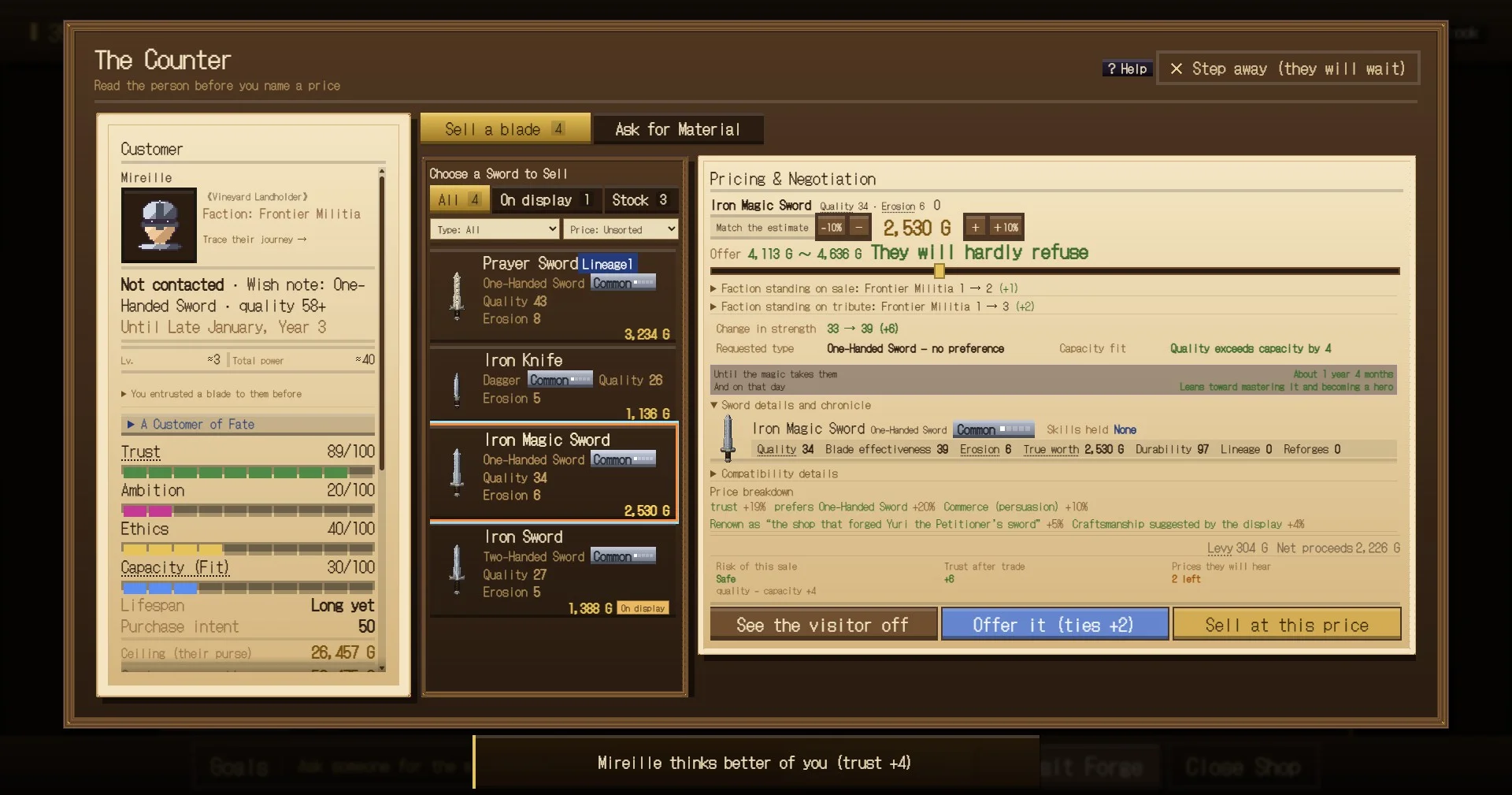
Selling things directly is more interesting: the game shows an approximate price range and hints at how willing someone is to accept your offer. Let's say a blade is valued at six to eight thousand gold. You adjust the price, check the likelihood of a deal, and decide how much more you can ask. Sometimes it's obvious that the buyer will almost certainly agree. Other times, they won't buy anything at that price.
After the talking-sword incident, I started paying more attention to these hints. Knowing the true value of an item is useful, but the other person can still tell you to take your calculations and shove them. Thankfully, my visitor came back later.

There's also a counter. Displaying weapons makes your shop more attractive, and a visitor might want to buy a specific item from it. The catch is that you set the price in advance, and there's no haggling. I tried putting a sword worth around a thousand gold up for sale at two thousand. Nobody bought it. I lowered the price, but it still sat there. Another blade was eventually sold from my counter, so the system definitely works. My attempt to find a generous fool simply didn't pan out that time.

As time goes on, you want to get better at understanding both prices and customers. That's where skill progression comes in: appraisal, smithing, trading intuition, negotiation, and management. Each branch has around four talents. I was at least able to put appraisal to use in a specific purchase right away. I learned the sword's value, tried to haggle, and ended up without the sword. Useful experience, I suppose.
Finally, a War Breaks Out
There are plenty of forge upgrades, but initially you simply can't afford most of them. Warehouse expansion, trading network, repairs. The forge itself also requires maintenance, though I never got to the point where I needed to repair it during my playtime. There were enough other expenses.
My first substantial earnings came when a war broke out between two factions. Orders arrived for specific weapons with quality requirements. You can find more games featuring medieval weapons in the article 19 Games Like Kingdom Come: Deliverance — Realistic Medieval Games on PC and Consoles (2026). Quality depends on materials, so you can no longer just throw whatever you have into the forge. But the pay was substantial. Demand for expensive weapons increased, and I finally started making money from them.

That's when the magical stone that instantly produces a finished weapon came in handy. Before the war orders, I barely used it. I could take my time, wait a month, open the shop, and see who showed up. With military orders, I wanted to craft something expensive as quickly as possible and sell it while the money was good.
I also remember a priest who came in to complain about trading in magical weapons. I told him we don't sell them under the table to priests like him. The conversation was brief. I carried on trading.

You can also keep expensive blades for yourself. There's a magical sword museum with six display stands. As far as I could tell, displaying weapons there doesn't give you anything. They just sit on display. I wasn't ready to put away anything I could still sell. After those first few months of barely scraping by, I wasn't exactly in a collector's mindset. Still, the game claims to feature 225 weapon types, and I haven't unlocked nearly all of them. I'm sure I'd eventually find something worth keeping.
There are also letters containing rumors about rare materials. Nothing is confirmed, but you can pay a traveler 80 gold and send them to investigate. The search takes several stages, after which they bring back the material. Compared to an ordinary shop order, it's at least a little side activity of its own. The money's spent, and now you wait to see what comes of it.
Üretim oyunlarında en çekici bulduğunuz şey nedir?
How Much Time Does Everyone Have Left?
Weapons don't disappear from the game along with their buyers. You can use the Observation Crystal to look up acquaintances and find out what's happening to their blades. Some people lose their weapons. Then they come back, and you can sell them another one. Others never use their purchase at all, so the weapon hasn't developed much of a story. It just sits with its owner. After all the calculations I've done regarding rarity and value, I'd like to see buyers actually use their weapons from time to time.

The girl with the talking sword stood out precisely because something actually happened with her purchase. Later, I saw the consequences of buying it back: she had calmed down. And the same sword behaved normally with its next owner.
The same encyclopedia also shows how much time people have left to live. I opened the profile of the girl who had visited my shop and saw that she had only five years left. Until then, I'd been busy with materials, prices, and figuring out how much I could get for another blade. I had to stop and spend a moment looking at that profile. And eventually, a death board appears, too. Visitors really do die.

After two years, some conversations had already started to wear thin. Someone is still looking for materials, and I keep accepting their reports. You can sell them something, close the shop, and move on. Sometimes a visit leaves you with almost nothing to remember. But now I occasionally open the encyclopedia and check how much time they have left.
***
Eternal Swordsmith is a laid-back forge simulator where most of your time is spent selecting materials, talking to customers, and trying to earn enough for your next batch of weapons. What I enjoyed most was watching the trading business gradually develop into a collection of personal stories. It's a shame that visitors often have nothing new to add to previous conversations, and waiting for the next event can drag on. But if you enjoy slowly building up your business and watching the lives of familiar characters unfold, this forge might keep you occupied for a few evenings.